Designing for the Cliff: Calibrating Load to Reach maxmemory in a 1-Hour Run

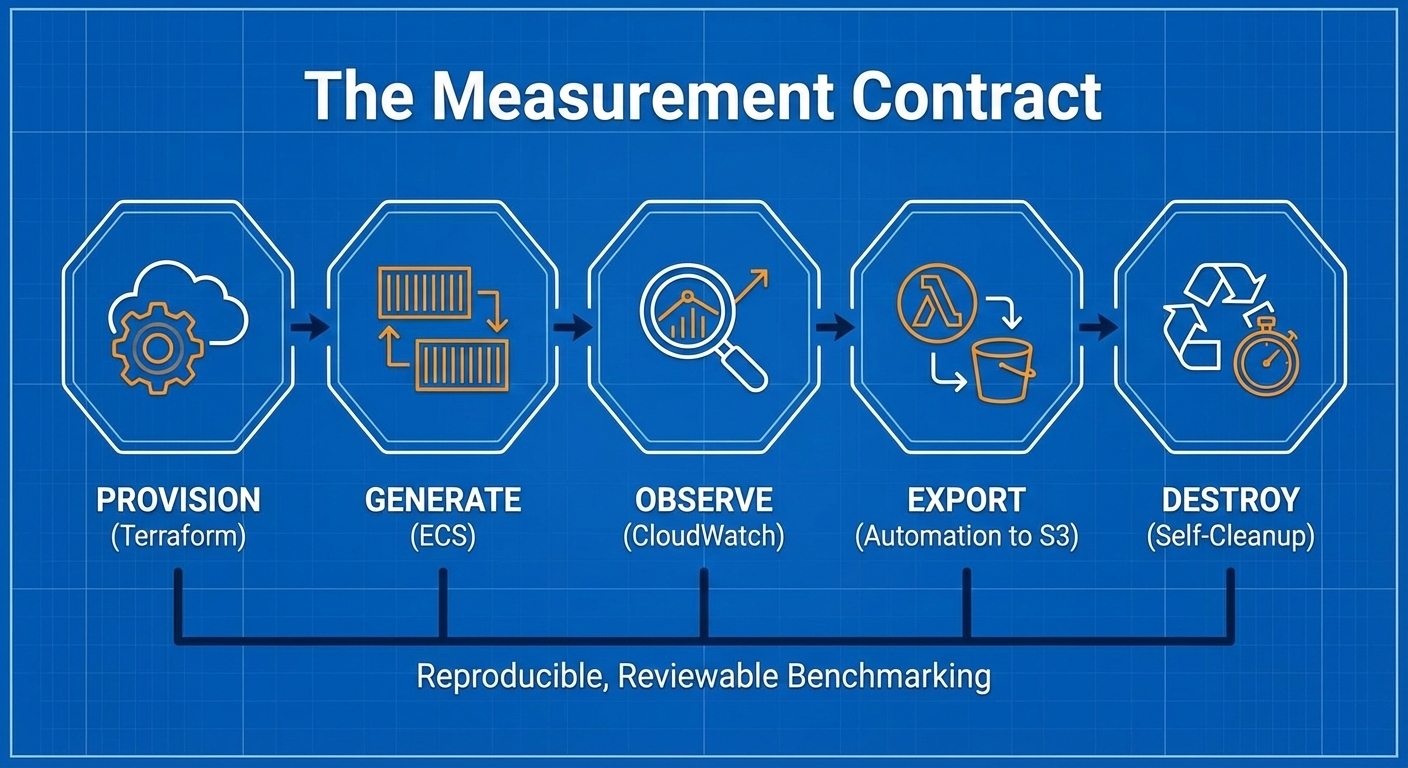
This project has a hard contract: every run is exactly one hour. That constraint is what keeps results comparable across configurations and makes exported visualisation consistent.

After I fixed shutdown reliability, the next issue wasn't infrastructure. It was methodology.

The discovery: the "happy path" trap

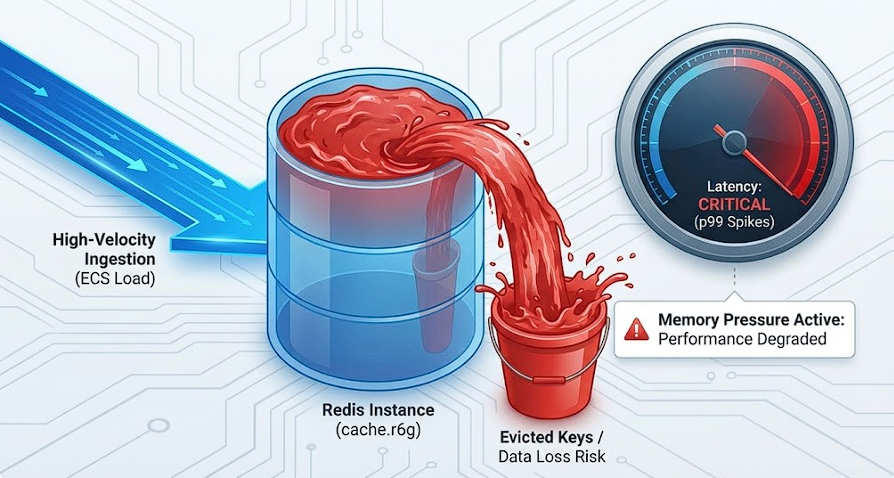
Reviewing telemetry from a standard run, I noticed that my default load generation (single ECS task) was not reliably pushing Redis into the state I actually care about.

Memory usage was climbing, but in many cases the run could finish without reaching maxmemory. That means the test is still useful as a smoke check, but it's not a strong performance validation: it mostly measures a cache that's not under pressure.

Links:

Shutdown Didn't Happen: Placeholder Semantics Bug

AWS ElastiCache Lab project has a hard rule: a test run is defined as one hour. That only stays true if the lab reliably shuts down on schedule. If it doesn't, I lose cost control and-more importantly for benchmarking-I risk starting the next run from a non-clean baseline.

I hit exactly that problem on an evening run.

What I observed

The run finished, but the environment was still up. Nothing looked "broken" in the usual sense: services were alive and responsive. In this lab, though, "still works" past the run boundary is a defect, because it means the lifecycle automation failed silently.

Links:

Beyond Documentation: Building a Data-Driven Test Lab for ElastiCache

Docs Confidence is that warm, fuzzy feeling you get after reading AWS whitepapers - right before your cache hits 99% memory, your p99 latency grows a tail, and your assumptions start to melt. It's not incompetence, it's the gap between documented behavior and observed behavior under your specific workload.

I built this repeatable ElastiCache benchmarking platform to close that gap with receipts: timestamped telemetry and exportable artifacts that stand up in a design review. This lab isn't just about Redis (or Valkey) as software, it's about the architectural decisions that land in production: which engine, which instance class, and which topology delivers the best outcome for the budget.

Links:

AWS ElastiCache: Types of Data You Can Store and Manage

  • ElastiCache for Redis:
    • Can handle different kinds of data like text, numbers, and lists of items.
    • Useful if you need to organize data in various ways, not just save single pieces of information.
  • ElastiCache for Memcached:
    • Mainly for storing single pieces of information and finding them quickly.
    • Good for simple needs like remembering a user's profile or speeding up commonly requested data.


Links:

Caching in on Performance: How Caching Mechanisms Transform Financial Systems

Coffee shop analogy illustrating caching in finance

Picture your favorite coffee shop, where the barista knows your order and hands it to you right away. Caching in finance works similarly, ensuring systems run efficiently and fast in both B2C and B2B scenarios. In this post, we'll demystify caching through relatable examples and explore mechanisms like CDN cache, application-level cache, and built-in database caches. Discover how caching powers seamless financial experiences, all while keeping things simple for non-technical readers.

Links:

Say Goodbye to apache-, php, and php-pecl-* packages in Amazon Linux 2023: Here's What to Do Next!

Why the Removal?

Amazon is always striving to improve its products, and that includes keeping software packages up-to-date and secure. The apache-, php, and php-pecl- packages were removed from Amazon Linux 2023 due to outdated software and compatibility issues. As technology advances, it's essential to stay on top of these changes to ensure the best possible experience.

Links:

optimization with memcached - is it simple to implement?

memcached is service which provide memory cache storage. It can provide access to cached object via network and it is extrimly fast!

memcashed pecl module is a way which can be used to access cache storage. How it work? It more complicated instead Cache_Lite, but it is fastest. This fact can be explain: Cache_Lite use file system to store cache objects.

Links:

Why Drupal.

Drupal(www.drupal.org) is CMS system with very long development history. I work with since 2003 and create many custom modules for my clients, I work with WordPress, osCommerce and ZendCart too, but Drupal is my choose, because it have all what I need and want.

Tags:
Links: